
Part 3 · Before the Finished Photos
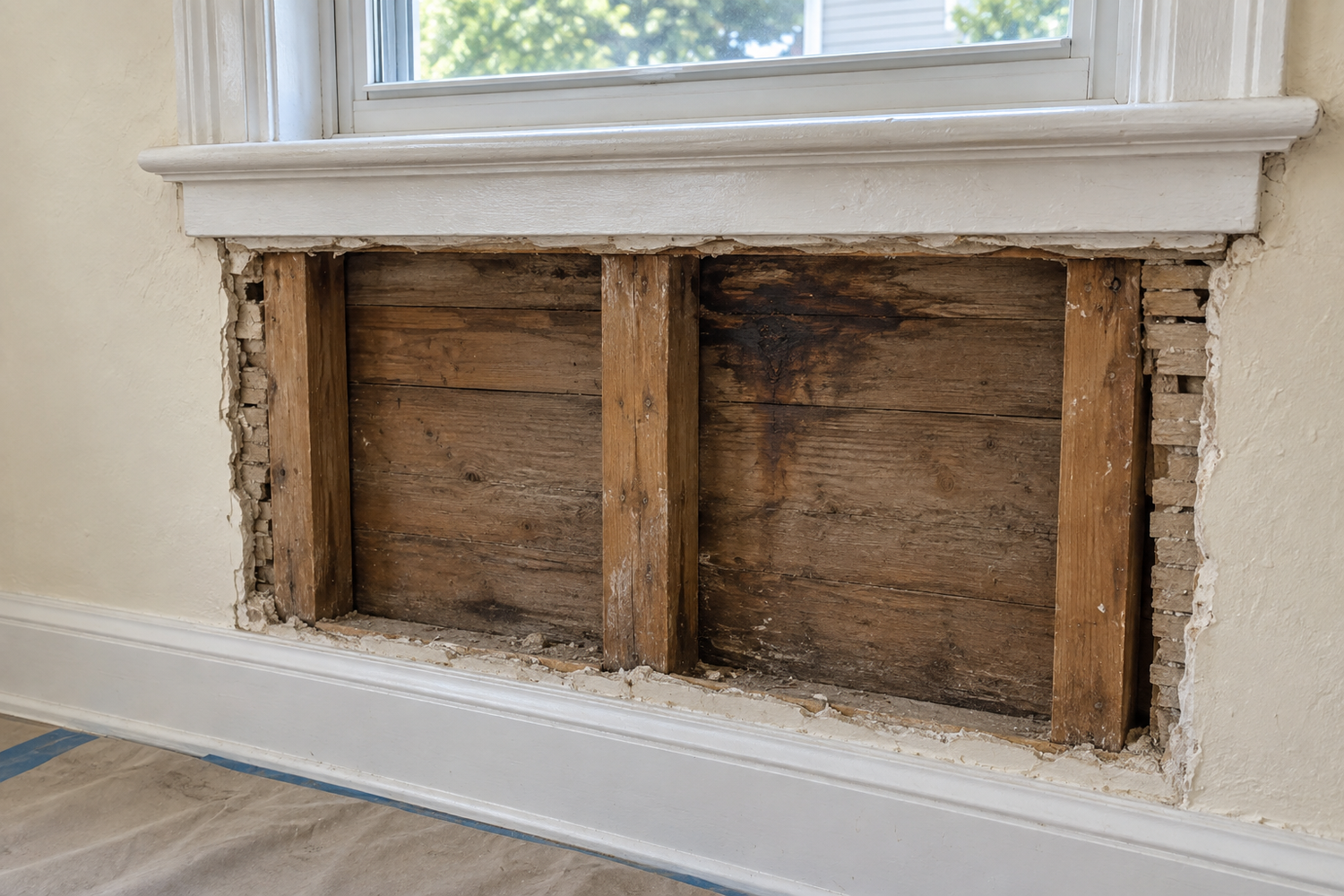
The wall looked ordinary yesterday. Today, part of it is open, and there is something behind it that needs a closer look.
That moment can change the feel of a project. You were picturing a finished room. Now you are hearing about a condition you did not know existed, and your first questions are likely practical: How serious is it? What will it cost? Why was it not found sooner?
Those are fair questions. A hidden condition deserves a careful explanation and a clear process for deciding what happens next.
A home has a history you cannot always see
An existing house may have been altered by several owners. Repairs may be concealed by finished surfaces. A space that appears straightforward from the room side can contain details that are different from the assumptions used during planning.
For example, opening a wall near an older window might reveal discolored or deteriorated material. That is a reason to investigate the condition and its cause. A photograph alone does not establish the full extent of a problem or the appropriate repair.
A garage project can raise similar questions. An existing slab or foundation should not be assumed suitable for new work simply because it is already there. Its condition and suitability for the proposed use need to be considered in the project planning.
These examples describe possible situations, not findings from a particular Reformation project. Every house needs to be evaluated on its own facts.
Good planning should reduce unanswered questions
Some conditions can be investigated before construction. Measurements, records, visible inspections, and targeted evaluation can help clarify the work. When more investigation is appropriate, its purpose, limitations, and effect on the home should be discussed.
Other conditions may remain concealed until the project reaches a particular stage. Planning should identify those uncertainties where possible instead of quietly treating an assumption as a confirmed fact.
This is one reason we discuss the value of preparation in our article about pre-construction agreements. The purpose of planning is to develop a better understanding of the project and the decisions it requires.
A useful question is, “What are we assuming about the existing home, and how will that assumption be checked?” It invites a more meaningful answer than a general assurance that everything should be fine.
Start with evidence, then establish the next step
When something unexpected appears, the first conversation should explain what was found, where it was found, and how it differs from what had been anticipated.
At Reformation, we explain the reason for a change order through photographs, video, or an in-person discussion. That explanation should help you understand the issue; it should not require you to become a construction expert to follow the conversation.
Some findings need further evaluation before the solution can be established. The contractor should explain whether another qualified professional needs to assess the condition and which work is affected while that happens.
There is a difference between identifying a concern and knowing its full scope. Ask which conclusions are confirmed and which are still under investigation. That distinction helps prevent an early possibility from becoming an assumed final price or timeline.
The next decision should follow the evidence, with a clear explanation of what is known and what still needs to be understood.
A discovery does not answer every question about cost
Finding an unexpected condition and deciding who is responsible for the resulting work are separate questions. The agreed scope, the information available during planning, and the specific facts matter.
A hidden condition is not a blanket explanation for every added charge. A contractor mistake or an omission should be discussed on its own merits. Homeowners should be able to ask how the proposed work relates to their existing agreement.
If additional work is proposed, ask what it includes, what alternatives are reasonable, and whether its price is established or depends on further investigation. Where the answer is incomplete, the document should make that uncertainty understandable.
Reformation provides a written change order detailing our reasoning and sends it to the customer for review and sign-off. Except in an emergency, we do not proceed with the change-order work until we receive written approval by signature.
Five questions when something unexpected is uncovered
- What was found, and how is it different from what the project assumed?
- What evidence can you show me, and what remains uncertain?
- Does anyone else need to evaluate the condition before a solution is chosen?
- What options are available, and how would they affect cost and timing?
- What written decision is needed before the affected work proceeds?
Keeping room in the plan for uncertainty can help, but there is no single reserve amount that makes every project predictable. Discuss the particular uncertainties in your house and how additional work would be evaluated and approved.
You deserve an explanation before a decision
Unexpected news can make a homeowner feel as though the choices have suddenly narrowed. Sometimes a condition truly must be addressed before the project can continue. Even then, the reason and the proposed response should be explained clearly.
You do not need to minimize your concerns about the cost. You also do not need to decide from a photograph and a hurried sentence. Ask for the information that makes the recommendation understandable.
An existing home will not always reveal everything at once. A thoughtful process helps everyone respond to what it reveals with better information, documented decisions, and realistic expectations for the work ahead.